The Approach – GSR® MODEL: Governance, Security and Resilience
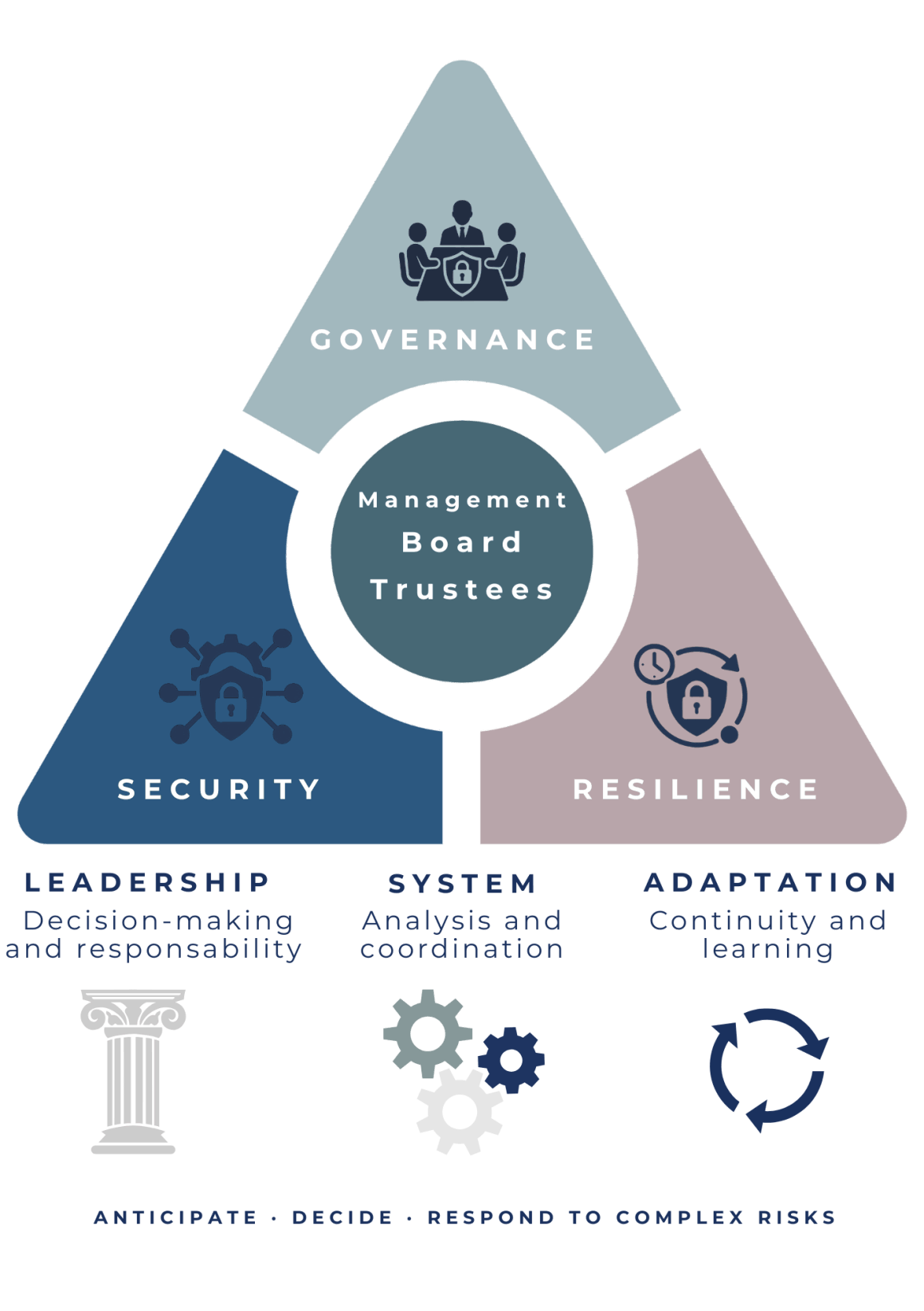
The GSR® Model is a strategic framework designed to strengthen an organization’s capacity to anticipate, decide and respond to complex risks.
Security, Leadership and Resilience for Organizations That Cannot Afford to Fail
I advise executive boards, governing bodies and senior leadership teams on decision-making related to the protection of people, critical assets and institutional reputation, integrating security, leadership and organizational resilience.
The GSR® Model is a strategic framework designed to strengthen an organization’s capacity to anticipate, decide and respond to complex risks.

Security begins at the decision table.
Governance defines who decides, with what information, under which criteria and with what level of accountability.
Without leadership involvement and clear responsibilities, no security system can be effective.
Security must function as a coherent system, aligned with institutional purpose and real risk exposure.
This includes risk analysis, internal and external coordination, and consistency between strategy and operations.

Resilience is not improvised during a crisis. It is built through preparation, continuity planning, adaptive capacity and organizational learning.
Security begins at the decision table.
A strategic assessment of governance structures, security systems and critical risks, designed to support board-level decision-making.
The design of a security governance framework aligned with institutional mission, values and long-term risk exposure.
Ongoing independent advisory support to boards, governing bodies or senior leadership teams (6–12 months).
High-level training focused on leadership, governance of security and decision-making in complex environments.

I have developed my professional activity in organizations with high institutional, social and reputational exposure, where security, risk and continuity cannot be addressed through purely operational or technical approaches.
My work focuses on strategic advisory support to executive management, boards and governing bodies, integrating security governance, risk management and organizational resilience.
Key Areas of Strategic Experience:
· Complex healthcare systems
Leadership of the security function within large-scale healthcare environments, with a strong focus on operational continuity, protection of people and decision-making under sustained pressure (Servicio Gallego de Salud, Quirón Salud and Clínica Ruber Internacional).
· Cultural heritage and symbolic institutions
Governance of security in cultural assets of exceptional historical, social and symbolic value, balancing protection, public access and institutional reputation (Catedral de Santiago de Compostela; Biblioteca Nacional de España).
· Universities and academic environments
Strategic advisory work in security and risk management across university campuses, integrating safety, coexistence, academic freedom and institutional responsibility (Universidad Rey Juan Carlos).
· Science, research and knowledge-based institutions
Direction of security in scientific research centers with international projection, with particular attention to the protection of knowledge, people and critical assets (National Center for Research on Human Evolution).
· Organizations with high reputational exposure
Strategic management of security in human rights organizations and sensitive environments, where anthropogenic and reputational risks are structural to daily activity (Amnesty International Spain).
In addition to the core projects outlined above, my professional background is reinforced through:
· Specialist training and advisory work on the protection of soft targets in international and multilateral contexts (Organization for Security and Co-operation in Europe, OSCE).
· Expert advisory roles in corporate security for major private-sector operators.
· Academic and teaching activity in security, risk and leadership within higher education (Universidad Católica de Ávila).
· Ongoing professional training of private security practitioners within the Spanish institutional framework (Ministry of Interior of Kingdom of Spain).

For over three decades, my work has centered on careful and steady protection. As an independent strategic advisor in security, risk, and organizational resilience, I support executive leadership, boards, and boards of trustees in contexts where people, critical assets, and institutional reputation are at stake.
My experience is rooted in environments where complexity is the norm rather than the exception: universities, cultural heritage institutions, and the industrial–food sector. I'm familiar with settings that are characterized by high operational demands and significant social and reputational exposure.
Together, we can approach security as a matter of governance, leadership, and continuity. We'll focus on connecting risk analysis, the security function, and the development of managerial and operational capabilities into structures that allow organizations to function, decide, and endure under pressure.
This work is grounded in long-standing practical experience in sensitive contexts and supported by a solid academic and training background, developed at both national and international level.
Protecting critical assets is leadership in action.
If your organization requires independent, senior-level judgement on security, governance and resilience, we can arrange a confidential professional conversation.
Send the form or email to info@ricardosanzmarcos.es